
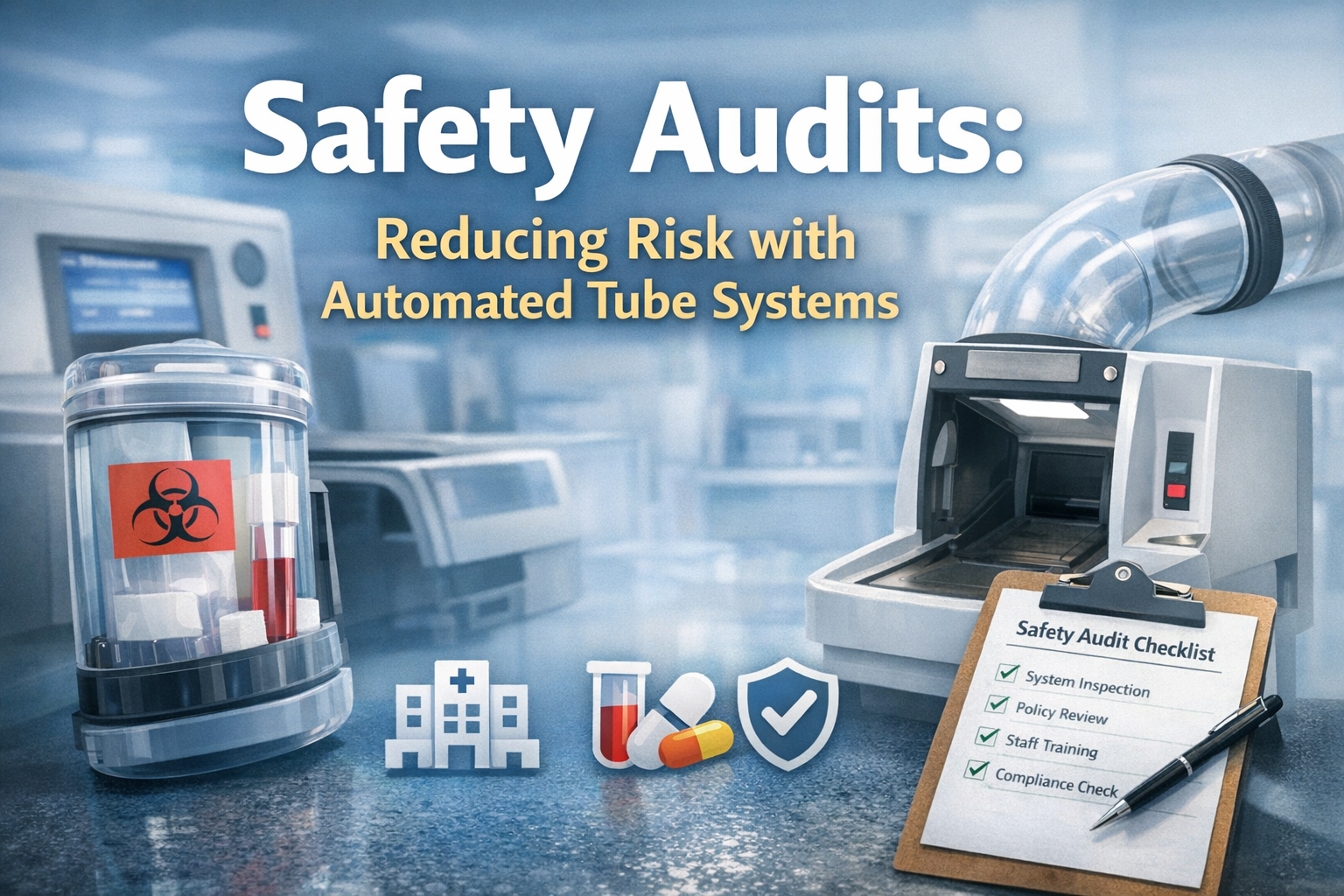
Automated tube systems are the quiet workhorses of many hospitals, moving specimens, medications, and documents behind the scenes, 24/7.
When they work, no one notices. When they don't, everyone does:
Specimens arrive hemolyzed or late.
Medications show up on the wrong unit.
Tube stations back up, and staff stop trusting the system.
Because tube systems touch so many clinical workflows, they're a patient safety and compliance issue, not only a facilities issue.
That's why regular safety audits of automated tube systems are essential. They help you find risks before they become incidents, prove compliance to regulators and accreditors, and make sure the system supports care instead of undermining it.
This article explains what to include in a tube system safety audit, who should be involved, and how to turn findings into practical improvements.
Why Automated Tube Systems Need Safety Audits
Hospital pneumatic tube systems are:
Physically large and complex (dozens of stations, long runs of tubing, multiple blowers and controllers).
Logically complex (routing rules, priorities, item restrictions).
Shared by many departments (lab, blood bank, pharmacy, wards, ED, OR, billing, etc.).
Risks range from:
Pre-analytical errors (hemolysis, temperature issues, leaks).
Medication safety problems (wrong item routed to wrong station).
Infection prevention concerns (inadequate cleaning, cross-contamination risks).
Operational failures (downtime, blocked routes, congestion).
Safety audits provide a structured way to verify that policies match practice, confirm that validation is still valid after system changes, and identify hardware, software, and workflow issues before they cause harm.
What a Tube System Safety Audit Should Cover
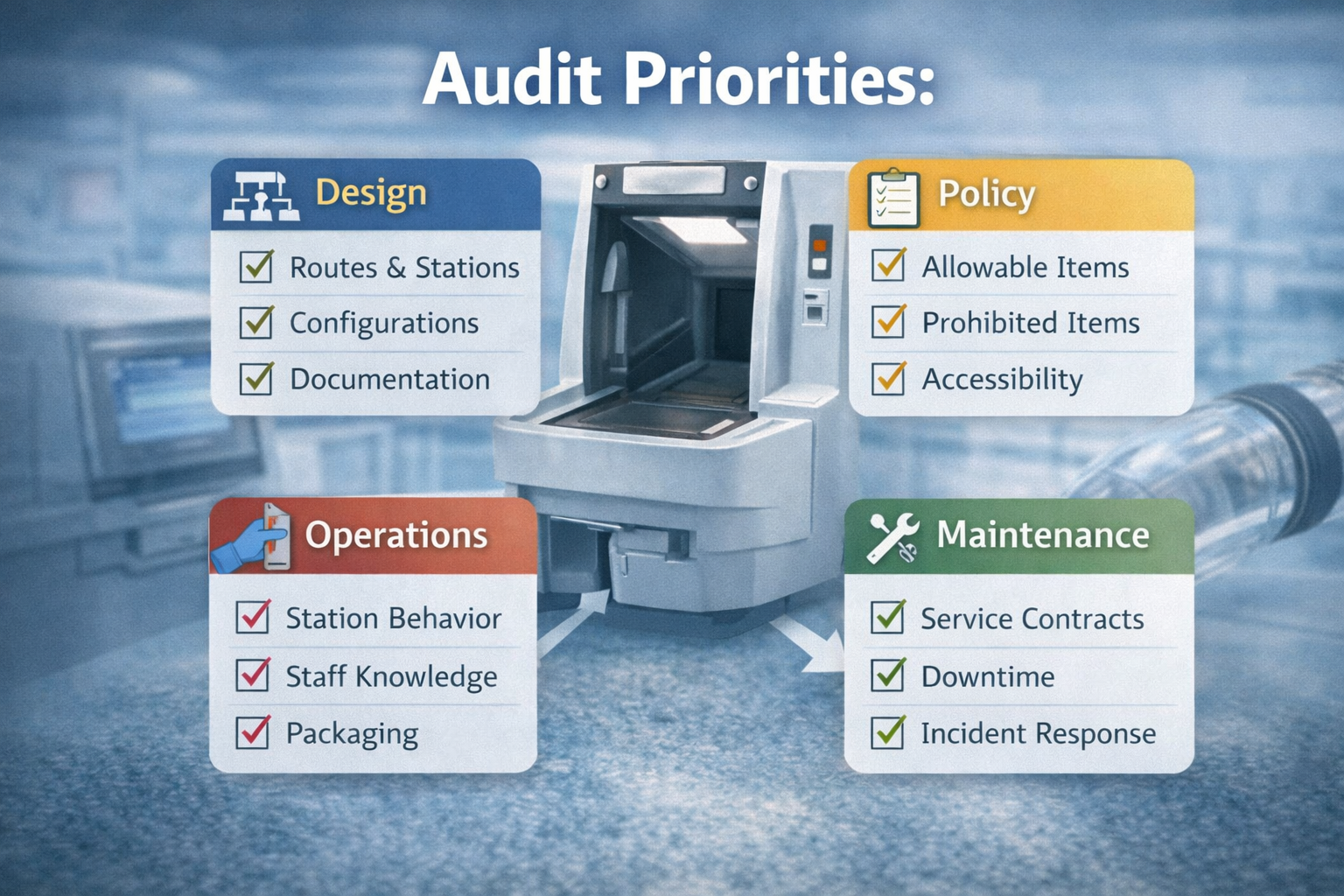
A good audit looks at four dimensions:
Design and configuration
Policies and allowable items
Daily operation and staff behavior
Monitoring, maintenance, and incident response
1. Design and Configuration
Things to check:
Are the routes and stations aligned with current clinical pathways (ED, OR, ICU, lab, pharmacy)?
Have there been building changes or service moves that the tube network hasn't caught up with?
Are high-risk routes (OR ↔ blood bank) designed with redundancy and priority rules?
Are station locations ergonomically sound and located where staff actually work?
Look at:
Network diagrams and "as-built" documentation.
Controller configuration: zones, priorities, routing logic.
Any changes since the last formal validation or major renovation.
Read more here: "Pneumatic Tube Systems in Hospitals: Design Best Practices for 24/7 Reliability."
2. Policies and Allowable Items
Look at your hospital pneumatic tube system safety policies:
Is there a clear, updated list of acceptable specimens and items for tube transport?
Does it specify items that must never be tubed (certain blood products, specific meds, very fragile specimens)?
Are policies aligned with validation data and manufacturer recommendations?
Are policies easily accessible where decisions are made (tube stations, collection points, pharmacy)?
Compare policy to practice. Interview staff on units, in lab, and in pharmacy. Do they know what can and cannot go in the system? Review recent incidents: were any caused by items being tubed that shouldn't have been?
3. Daily Operation and Staff Behavior
Observe and assess:
How staff package items in carriers (cushioning, labeling, secondary containment).
Whether carriers are overloaded, under-padded, or poorly closed.
Whether tube stations are emptied regularly or left full for long periods.
How often staff bypass the tube system and walk items, and why.
Questions to explore:
Do staff trust the tube system for the items it is approved for? If not, why?
Have shortcuts emerged (sending restricted items via tube "just this once")?
Are there unit or shift differences in how the system is used?
This reveals gaps between written procedure and real-world behavior.
4. Monitoring, Maintenance, and Incident Response
Look at:
Maintenance logs and service contracts. Are preventive visits on schedule?
Downtime records. How often is the system down, and for how long?
How quickly known issues are escalated and resolved.
Whether there's a formal downtime procedure for when the tube system is unavailable.
Also review:
Incident and near-miss reports involving tube transport (lost or misrouted items, leaks, damaged specimens).
Whether these events lead to documented corrective actions.
Tie this into your Hospital Maintenance Agreements approach and broader patient safety and quality improvement structures.
Who Should Participate in a Tube System Safety Audit?
Because automated tube systems cut across departments, audits should be multidisciplinary:
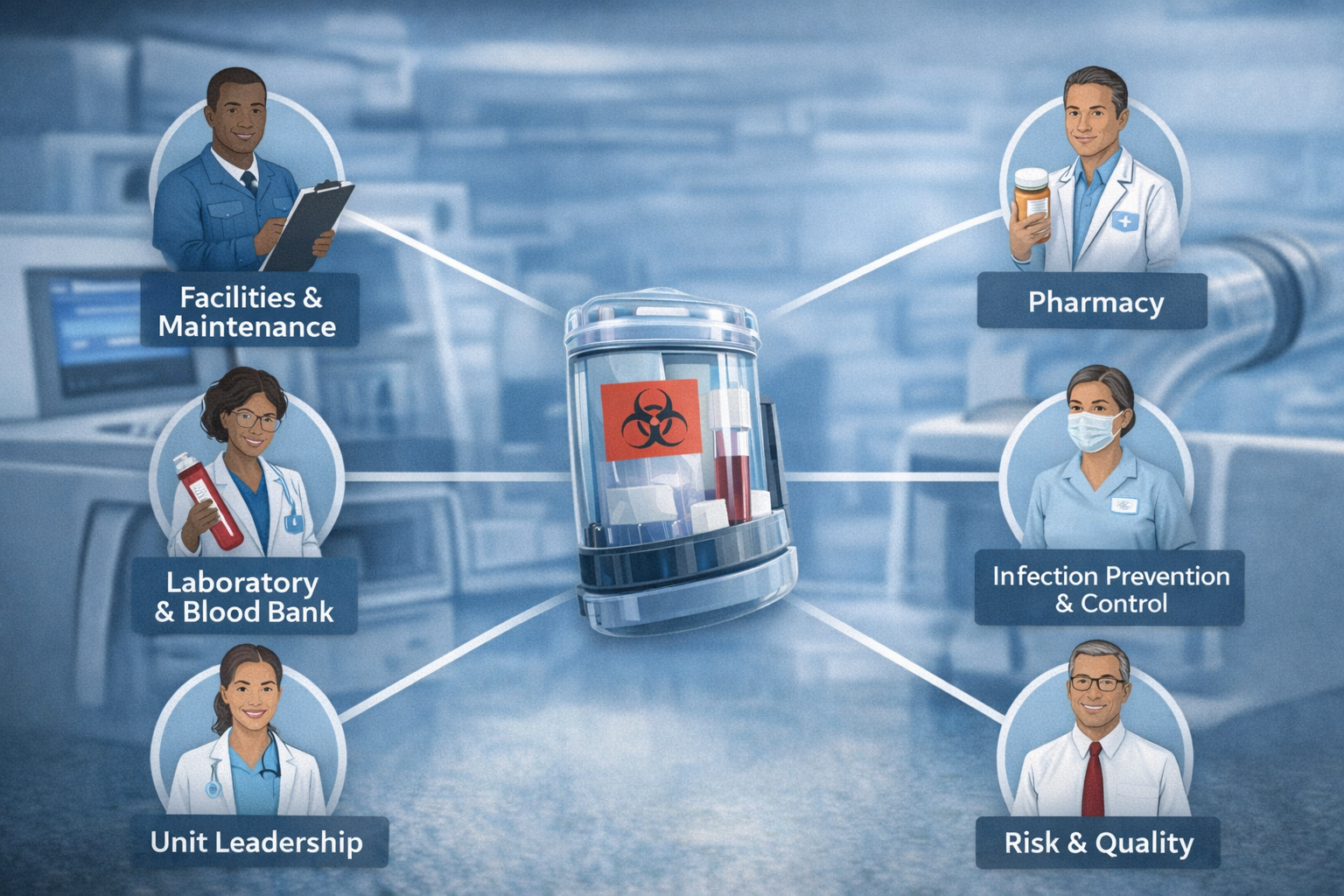
Operations / Facilities / Support Services Understand system infrastructure, maintenance, and vendor relationships.
Laboratory and Blood Bank Focus on specimen integrity, pre-analytical quality, and turnaround time.
Pharmacy Address medication safety, controlled substances, and labeling.
Nursing and Unit Leadership Provide frontline perspective on how the system is actually used.
Infection Prevention & Control Evaluate cleaning protocols and cross-contamination risks.
Quality / Risk Management Integrate audit findings into broader safety and compliance programs.
Having all these voices at the table makes sure the audit reflects real use, not only technical configuration.
A Practical Tube System Safety Audit Checklist
Below is a concise checklist you can adapt as a starting point.
Design & Configuration
Network diagram current and accurate
Stations located near real clinical workflows
Critical routes (ED, OR, ICU, Lab, Pharmacy) mapped and prioritized
Redundant paths for high-risk flows where feasible
Controller priority rules aligned with clinical risk
Policies & Allowable Items
Written policy listing allowed and prohibited tube items
Policy based on validation and manufacturer guidance
Policy easily visible at stations and collection points
Staff can articulate key do's and don'ts without reference
Process for updating policy after validation or system changes
Operation & Staff Behavior
Standard packaging and labeling instructions available at stations
Carriers in good condition with appropriate inserts
Stations emptied at defined intervals; no chronic backlogs
Staff use tube system for allowed items, not defaulting to walking
Unit-based workarounds documented and reviewed
Monitoring & Maintenance
Preventive maintenance schedule followed and documented
Downtime procedures written, tested, and understood by staff
Incident and near-miss events logged and investigated
Travel time and utilization data reviewed periodically
Actions taken when metrics or incidents show degradation
Turning Audit Findings into Action
A safety audit is only valuable if it leads to change.
Prioritize by Risk and Effort
For each finding, classify:
Impact on patient safety / quality (high, medium, low)
Effort to address (low, medium, high)
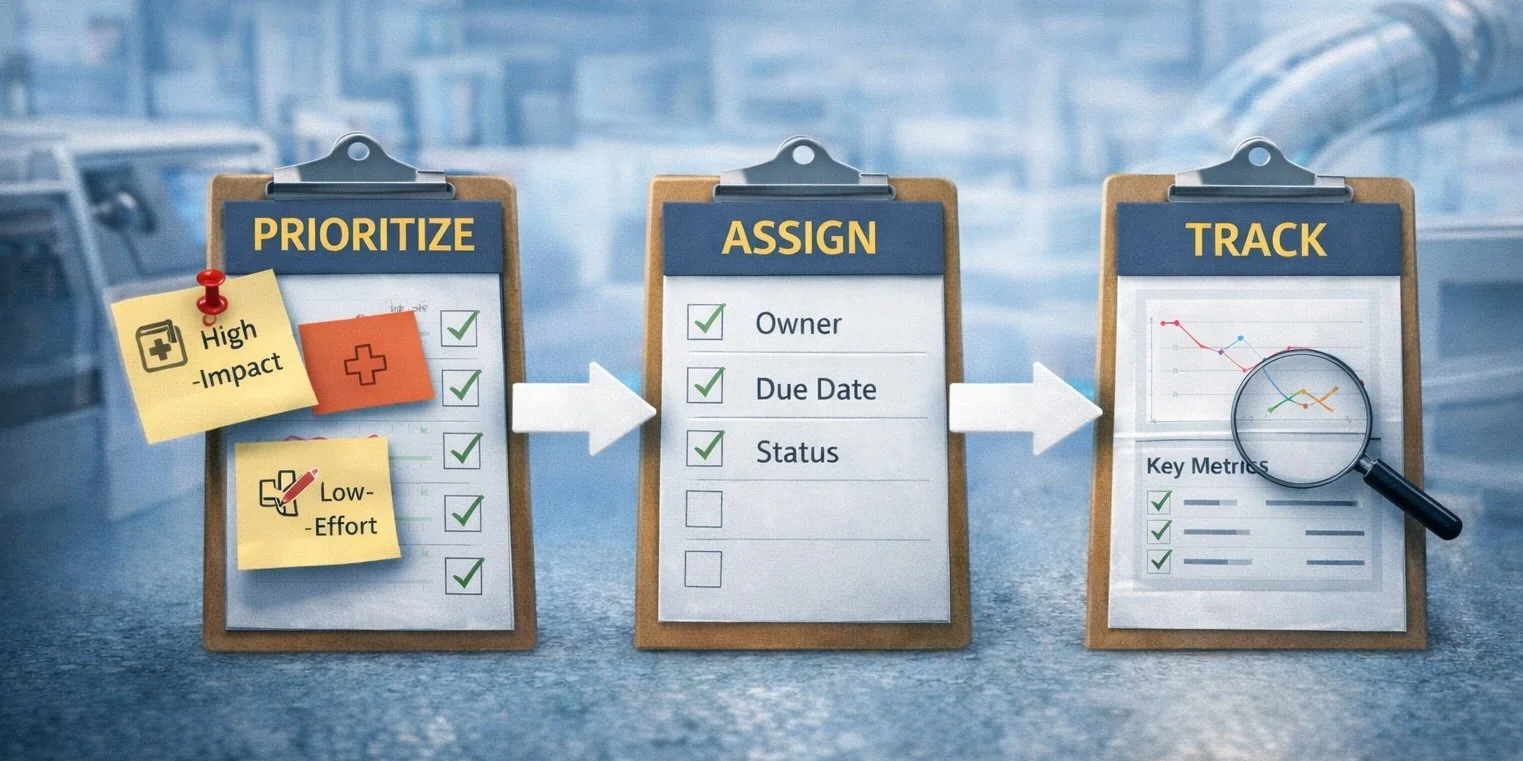
Start with high-impact, low-effort fixes (updating signage, retraining on packaging, adjusting route priorities), followed by high-impact, medium-effort fixes (validating additional routes, relocating a chronically overloaded station).
Track each action with an owner, due date, status, and how improvement will be measured (changes in hemolysis rates, fewer incidents, better TAT).
Communicate and Reinforce
Share audit findings and changes with frontline staff who use the system, department leaders who depend on it, and safety and quality committees.
Explain why changes are happening, how they reduce risk or improve reliability, and what staff should do differently as a result.
Transparency builds trust in both the system and leadership.
Atreo's Approach to Tube System Safety Audits
Atreo supports hospitals in designing and installing systems and keeping them safe and effective over time.
Our approach to tube system safety audits typically includes:
System review: design, configuration, routing, and priority rules.
Validation review: how pre-analytical integrity and acceptable item lists were established.
Field observation: watching how staff actually use the system on units and in the lab/pharmacy.
Data analysis: reviewing travel times, utilization patterns, and incident histories.
Action roadmap: prioritizing changes by risk and effort, with clear owners.
The result is a clear picture of where your automated tube system is helping and where it could be quietly adding risk.
Key Takeaways: Using Safety Audits to Reduce Risk
Automated tube systems are critical hospital infrastructure and should be audited like any other safety-relevant system.
Effective audits examine design, policies, daily use, and maintenance, not hardware alone.
Multidisciplinary participation is vital: lab, pharmacy, nursing, facilities, infection prevention, and quality all see different parts of the risk picture.
A simple, structured checklist makes audits repeatable and easier to maintain over time.
Turning findings into prioritized actions and communicating them widely is where risk is truly reduced.
Next Step: Talk with Atreo About Your Tube System Safety
If you haven’t reviewed your tube system in years, or if you’ve seen near-misses, rising hemolysis rates, or growing mistrust among staff, it’s time to take a closer look.
Contact Atreo to:
Discuss the current state of your hospital tube system
Get expert input on safety and compliance best practices
Explore practical options to reduce risk and improve reliability
Frequently Asked Questions About Tube System Safety Audits
How often should we audit our automated tube system?
At minimum, perform a formal safety audit annually, and any time there are major changes (new routes, building expansions, significant changes in specimen policies). Smaller, focused reviews can happen more frequently as part of continuous quality improvement.
Who should lead the audit?
Ideally, a joint team led by operations or support services, with strong participation from lab, pharmacy, nursing, infection prevention, and quality. What matters most is that the lead has the authority to convene stakeholders and drive follow-through on findings.
Do we need to stop using the system during an audit?
Not usually. Most audit activities (document review, observation, data analysis, interviews) can be done while the system runs normally. In some cases, brief route tests or maintenance checks may require temporary, localized pauses, but audits are generally designed to be non-disruptive.
